

Latest Post -:

Interesting Facts About Himalaya🌸Fault Lines: Understanding Earth’s Fractures and Their Impact on Our World🌸Vikramshila University: A Forgotten Beacon of Ancient Indian Learning🌸Greenland: The World’s Largest Island and Its Untold Stories🌸Fundamental Rights in India: A Complete Guide to Their Meaning, Scope, and Significance🌸Understanding the Significance of Fundamental Rights in India: A Comprehensive Guide🌸Fundamental Duties in India: Meaning, Evolution, Importance, and Contemporary Relevance🌸Understanding the Significance of Fundamental Duties in India: A Deep and Comprehensive Analysis🌸Kerch Strait: A Comprehensive Guide to Its Geography, History, and Strategic Importance🌸The Black Sea: A Complete Guide to Its Geography, History, Ecology, and Global Importance🌸Schools of Indian Philosophy: A Complete and In-Depth Guide to India’s Intellectual Traditions🌸President’s Pardoning Powers in India: Constitutional Authority, Scope, and Contemporary Relevance🌸Understanding the Organization of the Petroleum Exporting Countries (OPEC)🌸The British Conquest of Bengal: Power, Politics, and the Making of Empire🌸Daily Current Affairs, News Headlines 21.05.2026🌸Vocabulary For All Competitive Exams | 21.05.2026🌸Baghelkhand: A Deep Exploration of Central India’s Historical, Cultural, and Geographic Identity🌸Space Debris: Understanding the Growing Threat Above Earth and Its Impact on Our Future🌸Important GK Updates🌸Aditya Vikram Birla: The Visionary Industrialist Who Globalized Indian Business

“The Knowledge Library”

Knowledge for All, without Barriers…


An Initiative by: Kausik Chakraborty.
Interesting Facts About Himalaya🌸Fault Lines: Understanding Earth’s Fractures and Their Impact on Our World🌸Vikramshila University: A Forgotten Beacon of Ancient Indian Learning🌸Greenland: The World’s Largest Island and Its Untold Stories🌸Fundamental Rights in India: A Complete Guide to Their Meaning, Scope, and Significance🌸Understanding the Significance of Fundamental Rights in India: A Comprehensive Guide🌸Fundamental Duties in India: Meaning, Evolution, Importance, and Contemporary Relevance🌸Understanding the Significance of Fundamental Duties in India: A Deep and Comprehensive Analysis🌸Kerch Strait: A Comprehensive Guide to Its Geography, History, and Strategic Importance🌸The Black Sea: A Complete Guide to Its Geography, History, Ecology, and Global Importance🌸Schools of Indian Philosophy: A Complete and In-Depth Guide to India’s Intellectual Traditions🌸President’s Pardoning Powers in India: Constitutional Authority, Scope, and Contemporary Relevance🌸Understanding the Organization of the Petroleum Exporting Countries (OPEC)🌸The British Conquest of Bengal: Power, Politics, and the Making of Empire🌸Daily Current Affairs, News Headlines 21.05.2026🌸Vocabulary For All Competitive Exams | 21.05.2026🌸Baghelkhand: A Deep Exploration of Central India’s Historical, Cultural, and Geographic Identity🌸Space Debris: Understanding the Growing Threat Above Earth and Its Impact on Our Future🌸Important GK Updates🌸Aditya Vikram Birla: The Visionary Industrialist Who Globalized Indian Business

“The Knowledge Library”

Knowledge for All, without Barriers……….
An Initiative by: Kausik Chakraborty.

The Knowledge Library

Islands

Islands are land masses entirely surrounded by water. They are found in oceans, seas, rivers, and lakes. Islands vary in size from tiny rock outcrops to vast areas such as Greenland, which covers 2.2 million sq km (840,000 sq miles). There are two main types of island: oceanic islands which are remote from land; and continental islands, which often lie close to the mainland. Many oceanic islands are volcanoes. Continental islands are often formed by changes in sea level.

CONTINENTAL ISLANDS

Continental islands, such as the British Isles, rise from the shallow waters of continental shelves, which fringe the world’s continents. Often these islands were once part of the mainland, but were cut off when sea levels rose to flood the land in between. Smaller islands, called barrier islands, sometimes form off coasts where ocean currents or rivers deposit sand or mud.

CORAL ISLANDS

Coral islands, such as the Maldives in the Indian Ocean, are composed of the limey skeletons of coral polyps. Large colonies of these anemone-like creatures thrive in the warm, shallow waters off tropical coasts or around seamounts. The polyps’ soft bodies are protected by cup-shaped shells, which grow on top of one another to form rocky reefs that eventually break the surface. If the seamount subsides, just a ring of coral, called an atoll, may be left.
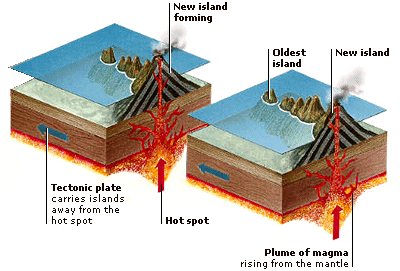
ISLAND CHAINS AND HOT SPOTS

Chains of volcanic islands sometimes form near the center of tectonic plates, in zones called hot spots. Some scientists believe that hot spots occur where magma plumes surge up from the mantle below. The magma bursts through a weak point in the crust to form an island. Over millions of years, the hot spot stays in the same place as the crustal plate drifts over it, forming new islands.

Also Read  Hunga Volcano

ISLAND ARCS

Oceanic islands are often formed by volcanic eruptions when plates collide. As one plate is forced below another, its crust melts in the red-hot mantle below. This molten rock rises up again to burn through the crust and erupt on the sea floor. Over time, the erupted rock forms a tall seamount and eventually breaks the surface as an island.

Sign up to Receive Awesome Content in your Inbox, Frequently.

We don’t Spam!
Thank You for your Valuable Time

Share this post

error: Content is protected !!